In accordance with its commitment to sustainability, Grupo Lamosa has identified the most important Environmental, Social and Corporate Governance (ESG) aspects for its operations.
These priorities were defined through a previous materiality analysis, which resulted in the establishment of a strategic sustainability model with five focuses, each in turn with different lines of action.
One of the achievements to highlight in 2023 was the institutionalization of a Sustainability Committee, which includes the management team, the industrial and human resources departments of Grupo Lamosa’s different businesses, the investor relations area, and corporate planning and development. The main objectives of this body are to continuously monitor the efforts made, identify new initiatives and address areas of opportunity.
The committee will also facilitate the consolidation of a sustainability strategy with defined indicators and possible goals.

The main objectives of the Sustainability Committee are to continuously monitor the efforts made, identify new initiatives and address areas of opportunity.
Grupo Lamosa’s strategic sustainability model is presented below:
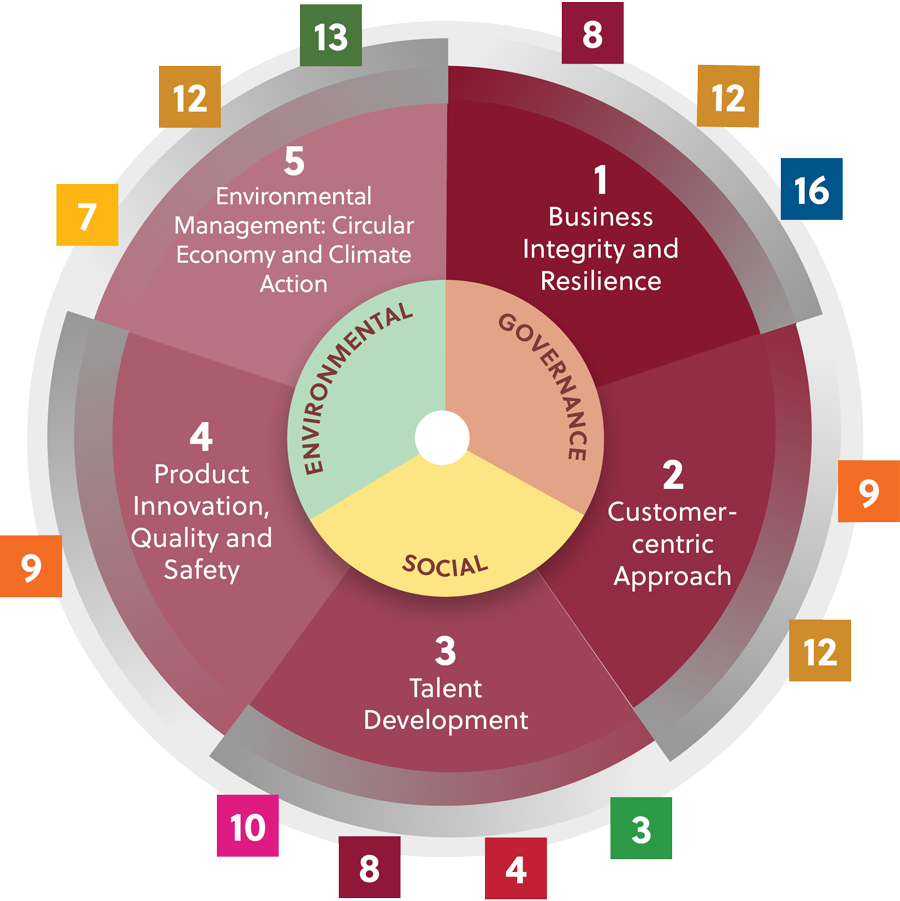
SUSTAINABLE DEVELOPMENT GOALS (SDGs) RELATED TO THE STRATEGY


ACTION LINES
1.1 Corporate Governance
1.2 Compliance Culture
1.3 Supply Chain Management
2.1 Sustainable Living
2.2 Customer Experience
3.1 Safety and Health
3.2 Employee Development
3.3 Work Environment
3.4 Community Contribution
4.1 Materials and Technology
5.1 Climate Action: Energy and Emissions
5.2 Circular Economy: Water and Waste
| FOCUS | PURPOSE | RELATION TO MATERIAL TOPICS |
|---|---|---|
| 1. Business integrity and resilience |
Ensure the company’s sustainability through decisions that consider a comprehensive medium- and long-term value proposition for all stakeholders, by promoting ethical practices and a culture of compliance that permeates all levels of the organization, including the supply chain. |
|
| 2. Customer-centric approach |
Improve the quality of life of customers by offering products which are adapted to their needs and which also contribute to making a more sustainable home/work center (using fewer energy resources, for example). |
|
| 3. Talent development |
Guarantee the safety, health and well-being of our employees, promoting their professional and personal development, creating teams operating in a positive working environment based on trust, and encouraging them to participate in the development of the communities as part of our responsibility as a good neighbor. |
|
| 4. Product innovation, quality and safety |
Offer products that meet the highest quality standards, guaranteeing customer safety and product durability, and making use of technology for process efficiency and product portfolio innovation. |
|
| 5. Environmental management: circular economy and climate action |
Optimize energy use and reduce GHG emissions, lowering the environmental impact, and work under circularity criteria in the design of processes, products and services, minimizing waste generation. |
|
Appendix 1.1 shows the organization’s priority stakeholders; Appendix 1.2 the materiality process in detail; Appendix 1.4 the specific contribution made to the Sustainable Development Goals (SDGs); and Appendix 1.6 the main quantitative ESG indicators.